
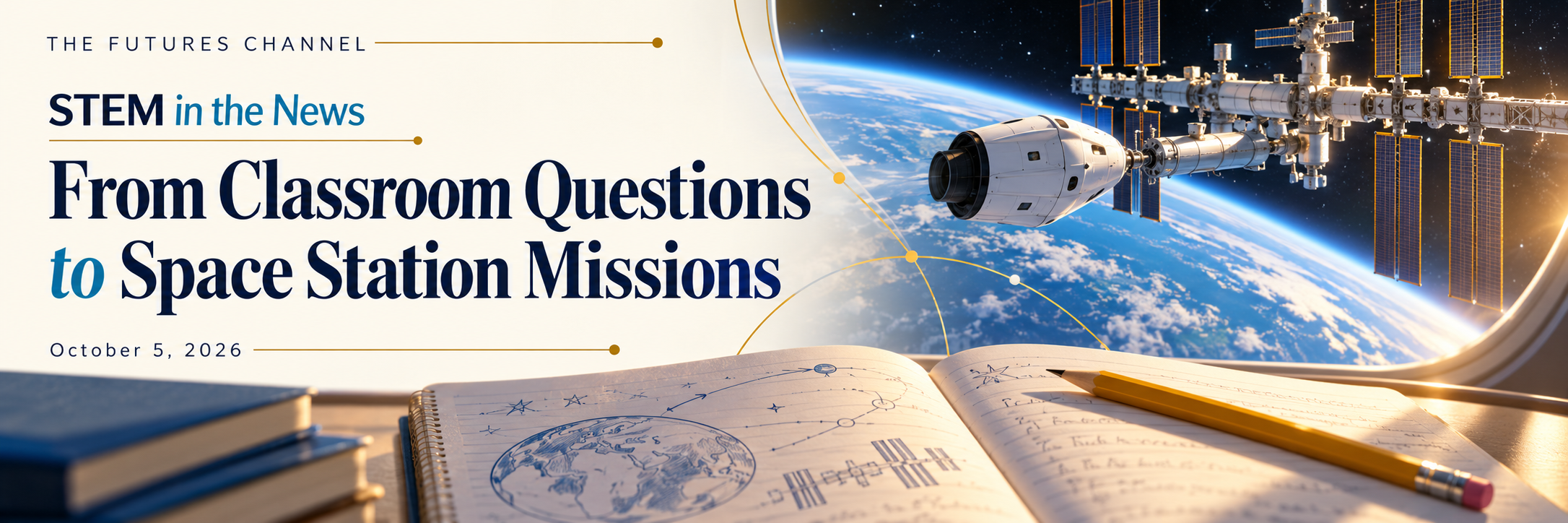
On October 1, four astronauts launched from Florida aboard a SpaceX Dragon spacecraft bound for the International Space Station. NASA’s Crew-13 mission offers teachers a timely way to revisit a question students may take for granted: What does it take to get people into orbit and keep them working there?
The Futures Channel video Spaceports provides a starting point. Its accompanying questions ask students to think about different goals for spaceflight: briefly traveling above Earth, remaining in orbit, or going farther to the Moon. Those goals call for different spacecraft, supplies, and engineering decisions. The video and its discussion material predate Crew-13; the October launch gives teachers a current example to examine alongside them. Check out the video here.
Crew-13 also shows why reaching the station is only the beginning of a mission. NASA says the astronauts’ planned work includes studies of human health in microgravity, a plant growth system, and the production of tissues derived from human stem cells for research. That gives students several ways into the story. A physics class might focus on launch and orbit. A biology class might ask why growing plants or studying blood flow in microgravity requires experiments. An engineering class might consider the equipment needed to carry out those experiments safely.
Classroom use: Before showing Spaceports, ask students to list what a spacecraft must carry for a brief trip above Earth. After the video, give them the Crew-13 report and ask what they would add or change for a mission that docks with an orbiting laboratory. Have students sort their answers into transportation, life support, research equipment, and safety. For younger students, a labeled drawing could replace the written list; older students can explain the tradeoffs behind their choices.
Discussion question: If the goal changes from a short trip above Earth to conducting experiments aboard the space station, which spacecraft requirements change most, and why?