
How can scientists study a planet’s earliest history without bringing a sample home from that planet? Sometimes the sample comes to Earth on its own.
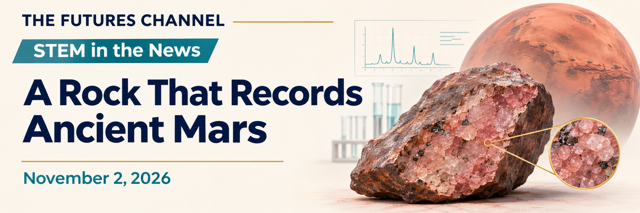
On October 29, NASA’s Jet Propulsion Laboratory described new research on Teghaza 001, a rose-colored meteorite discovered in the Sahara Desert in 2022. Scientists determined that the nearly two-pound rock came from Mars and contains material formed more than 4.1 billion years ago. That makes it one of the three oldest Martian meteorites identified on Earth.
Researchers found zircon crystals that preserve evidence of when the rock formed and when it subsequently changed. Using a highly precise rubidium-strontium dating method, they concluded that Martian water altered the rock around 4.1 billion years ago—meaning the original rock formed even earlier. Its mixture of volcanic minerals offers a rare record of Mars’s ancient crust and of interactions between rock and subsurface water.
Scientists did not simply accept that the meteorite came from Mars. They compared its oxygen isotopes—chemical fingerprints associated with different planetary bodies—with other Martian meteorites. They also compared its minerals and chemistry with measurements made by Mars spacecraft and rovers. Researchers identified 13 possible regions on Mars whose characteristics match the rock, although its exact point of origin remains unknown.
The Futures Channel’s The Surface of Mars introduces planetary geologist Molly McCanta and shows how researchers use Martian meteorites to investigate the planet’s geological history. The older video refers to a worldwide collection of 37 Mars rocks. NASA’s current report says roughly 435 Martian meteorites are now known. That difference should be presented as evidence of scientific progress, not as an error in the original resource.
Classroom use: Before showing the video, ask students what evidence would convince them that a rock found in Africa originated on Mars. Afterward, give them NASA’s report and have teams sort the evidence into four categories: age, minerals, isotopes, and comparisons with spacecraft data. Each team should identify which conclusions are strongly supported and which—such as the rock’s precise Martian origin—remain uncertain.
This exercise demonstrates an essential feature of science: new evidence can enlarge a dataset and refine an explanation without erasing the value of earlier work.
Discussion question: How can several independent kinds of evidence make the conclusion that a meteorite came from Mars more convincing?